
You already know light changes how you feel.
You've felt it under fluorescent lights at the end of a long day, when your head tightens and your patience runs out. You've felt it in the third gray week of January. And you've felt it the other way too, at the edge of a lake at sunset, when something in your chest lets go without being asked.
If your system reacts strongly to light, sound, or busy rooms, you may have been told you're "just sensitive." Sensitivity is information. It usually means your nervous system is paying close attention to its surroundings, and what comes in through your eyes and ears carries real weight.
That's why people ask me whether color therapy glasses work, especially the colored lenses that pair with the AO Scan. They want to know if the glasses do anything, or if it's a pretty idea with no biology behind it. The answer has a few layers, and I'd rather walk you through all of them than hand you a simple yes or no.
What are the AO Scan Light Wave Glasses?
The Light Wave Glasses are made by Solex, the company behind AO Scan. One frame comes with twelve interchangeable lenses that run the visible spectrum:
- Red
- Red-orange
- Orange
- Gold
- Yellow
- Lime
- Green
- Turquoise
- Blue
- Violet
- Purple
- Magenta
I really like how they're designed. The lenses attach to the frame magnetically, so switching from one color to another takes a few seconds.
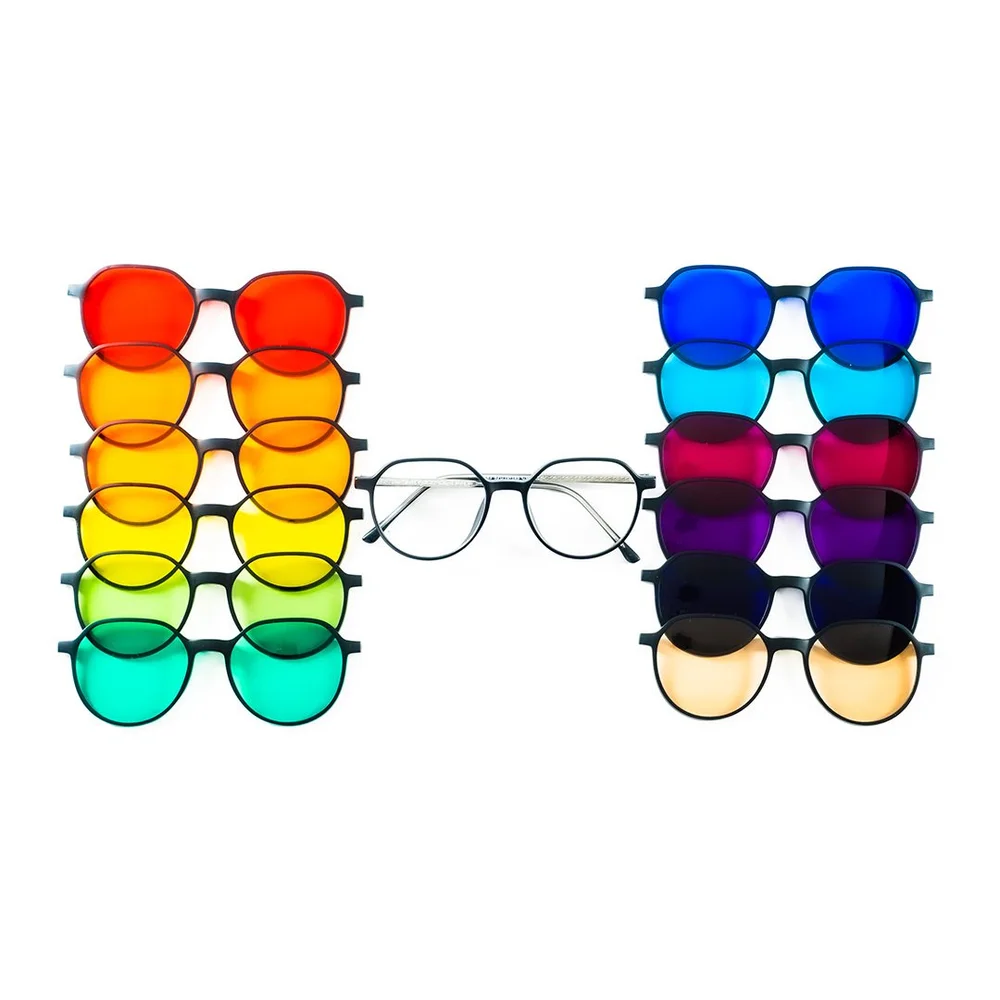
They're designed to be used with the Inner-Voice scan. Inner-Voice records a short sample of your voice, maps which of twelve musical tones are most and least present, and creates personalized audio built from tones and binaural beats. The report also suggests which lens colors to wear. Solex suggests about twenty minutes a day.
Watch: What Is an Inner Voice Scan?Opens on YouTubeSo the practice is simple. You sit, listen, and look at the world through one color for a while.
Color is a frequency, too
Here's the part I find beautiful, and it's the heart of how the Inner-Voice report connects sound to color. Every color you see is a frequency, measured in hertz, just like sound. Light simply vibrates far faster.
Visible light, in hertz
For comparison, middle C on a piano is about 262 Hz.
As frequency rises, color moves from red through orange, yellow, green, and blue to violet. Inner-Voice listens for twelve tones, the twelve notes of the chromatic scale, and the glasses come in twelve colors. That's why your report can point you from the notes in your voice to a lens color. Pairing notes with colors is an old idea. Isaac Newton divided the rainbow into seven colors partly to mirror the seven notes of a musical scale. As a piano teacher for fifteen years, I love that.
One honest clarification: the lenses don't produce a frequency of their own. They filter the light around you, letting one band of frequencies through and holding back the rest. And sound and light are different kinds of waves. Sound is pressure moving through air, light is electromagnetic, and your body takes them in through different doors. Matching a note in your voice to a color is Solex's framework, and it's a lovely one. It just hasn't been tested yet.
Has anyone studied light by its hertz? Yes, though researchers usually measure it in nanometers, the length of the wave, instead of hertz, how fast it vibrates. It's the same thing measured two ways: the shorter the wave, the higher the frequency. The blue range you'll see in the melatonin research below, 446 to 477 nanometers, works out to roughly 630 to 670 trillion Hz. So every wavelength study in this post is really a frequency study.
You'll also see "hertz" used a second way in light research: how fast a light flickers. The 40 Hz research from MIT I'll share later is about a light pulsing on and off 40 times a second, not about its color. The Light Wave Glasses don't flicker. They change the color, which means the frequency, of steady light reaching your eyes.
Let's dive into how that light actually reaches your brain, and what's worth talking about.
How does light reach the pineal gland?
Your eyes do two jobs. The first is vision. The second has nothing to do with seeing shapes. A small group of cells in the retina, called intrinsically photosensitive retinal ganglion cells, measure how much light is around you and what kind. They contain a pigment called melanopsin, which responds most strongly to blue light.
These cells send their signal along a dedicated nerve route to the suprachiasmatic nucleus, the body's master clock in the hypothalamus. From there the message travels down into the upper spinal cord, out through a cluster of sympathetic nerves in the neck, and back up to the pineal gland.
The pineal gland makes melatonin in darkness. When light reaches those retinal cells at night, melatonin production is turned down. In a study that mapped this in 72 people, wavelengths around 446 to 477 nanometers, the blue range, were the most potent at suppressing melatonin.
Two things stand out to me here. The human pineal gland doesn't sense light directly. It depends on the eyes and the nervous system to tell it what time it is. And the last stretch of that pathway runs through the sympathetic nervous system, the same branch that carries your stress response.
Light, your body clock, and your stress physiology share wiring.
This is why a colored lens has a physical effect. A lens is a filter. Amber, orange, and red lenses block most blue light. Blue and turquoise lenses let it through. Changing the color in front of your eyes changes the signal those clock cells receive.
Researchers have tested this with amber blue-blocking glasses worn in the evening, and the results so far are mixed. One hospital trial in people with bipolar mania found a large benefit within days. A larger trial in Ottawa found no advantage over lightly tinted lenses. The pathway is real. How much a pair of glasses can do with it is still being worked out.
Can color change your emotional state?
Light also reaches parts of the brain involved in emotion, and color seems to matter there too.
In a brain imaging study published in PNAS, people listened to voices with emotional or neutral tones while exposed to blue or green light. Under blue light, the brain's voice-processing area and the hippocampus responded more strongly to the emotional voices. Communication also increased between the voice area, the amygdala, and the hypothalamus. The color of the light changed how the brain handled an emotional sound.
Animal research adds a second route. In mice, some of those same retinal cells connect to a small region of the thalamus that links onward to mood-regulating areas, and this pathway influences mood separately from the body clock. That finding is in mice, so I hold it as a clue about how we might be built.
Green light has its own small body of research. Migraine researchers at Harvard found that green light aggravated headache less than white, blue, amber, or red light. At the University of Arizona, a preliminary trial had 29 people with migraine sit with green LED light for one to two hours a day, and headache days dropped by about 60 percent on average. A similar pilot in 21 people with fibromyalgia reported improvements in pain, sleep, and quality of life. These are small, early studies, and they used a light source in a darkened room, which is a different thing from tinted lenses.
Here's where I slow down. Traditional color therapy assigns each color a specific job: red for energy, blue for calm, and so on. A published review of color therapy for depression describes the evidence as limited, with small studies and weak controls. Wavelength clearly matters to the brain. A dependable chart of which color produces which feeling hasn't been established.
What does sound do to the nervous system?
The sound side has stronger research behind it.
A meta-analysis of 104 randomized trials found that music interventions lowered physiological stress markers like heart rate, blood pressure, and stress hormones. The effect on how stressed people felt was larger still.
Binaural beats, the kind built into the Inner-Voice audio, are a narrower topic. They happen when each ear hears a slightly different tone and the brain perceives a third, pulsing tone between them. A 2019 meta-analysis found a medium overall effect on anxiety, pain perception, and some thinking tasks. Individual studies since then have been inconsistent. One 2025 study found no change in heart rate, blood pressure, or skin response, with lower stress ratings at only one of three frequencies. I'd call binaural beats promising and unsettled.
When sound helps the stress response settle, the nervous system has better conditions for sleep, and sleep is where melatonin does its work.
Inner-Voice takes this a step further. The tones are designed around the emotional patterns picked up in your voice scan, so what you're listening to is built for you that day. After years of running these scans for myself and my clients, what I've witnessed has been amazing. And listening to those tones while wearing the glasses does seem to deepen the experience.
Why pair light with sound?
The PNAS study above is one answer. The brain blends what comes in through the eyes with what comes in through the ears, and that blend shapes the emotional response.
The clearest demonstration comes from Alzheimer's research at MIT, where light and sound are both pulsed 40 times a second. In their studies, the combination produced 40 Hz brain rhythms at recording sites that didn't respond to light or sound alone. In two patients with implanted electrodes, it reached deep structures including the hippocampus, amygdala, and insula. A small pilot of 15 people using it an hour a day for three months reported encouraging changes, and the authors say larger trials are needed.
That protocol uses flicker, which is very different from wearing a tinted lens while listening to tones. I include it because it shows the principle: paired sensory input can move the brain in ways a single input may not.
So, do the Light Wave Glasses work?
Here's how I sort it.
Well supported
Light entering the eyes reaches the body clock, the pineal gland, and emotional centers of the brain. Wavelength changes that signal. Music measurably lowers stress.
Promising and early
Specific colors for specific states, binaural beats, and combining light with sound.
In my practice I treat the glasses as a gentle sensory input, and I don't present them as a treatment for anything. Twenty quiet minutes with one color and one piece of sound asks very little of a tired system. For someone who has been living braced, a small, predictable input can be a manageable place to start noticing what settles them. Part of what helps may simply be the stillness and attention, and I'm comfortable with that.
I also bring the glasses into my Cognomovement sessions, and I've seen great outcomes there.
If you try colored lenses, what should you notice?
- Start small. Ten to twenty minutes, seated, with the audio.
- Watch your body more than your thoughts. Notice your breath, jaw, and shoulders, and whether your mind speeds up or slows down.
- Let your report guide you. Your AO Scan Inner-Voice report will recommend which lenses may be the best fit.
- Skip them while driving. Strong tints change how you see signals and brake lights.
- If a color feels agitating, take it off. How your body responds matters more than what the chart says.
If you're curious which tones and colors come up for you, you can read more about how I use AO Scan at Whole Body and Sole. If you'd like a monthly rhythm of scans and fresh tones, the Frequency Alignment Club is a gentle place to start. Reach out whenever you're ready.
Sources
- Solex. Light Wave Glasses product page and Inner Voice overview.
- Brainard GC et al. Action spectrum for melatonin regulation in humans. J Neurosci, 2001. PubMed
- StatPearls. Physiology, Pineal Gland. NCBI Bookshelf
- Henriksen TE et al. Blue-blocking glasses as additive treatment for mania. Bipolar Disord, 2016. PubMed
- Fiedorowicz JG et al. The Ottawa Sunglasses at Night Study. J Affect Disord, 2026. PubMed
- Vandewalle G et al. Spectral quality of light modulates emotional brain responses in humans. PNAS, 2010. PubMed
- NIMH. The pathways through which light affects learning and mood (Fernandez et al., Cell, 2018). NIMH
- Noseda R et al. Migraine photophobia originating in cone-driven retinal pathways. Brain, 2016. PubMed
- Martin LF et al. Evaluation of green light exposure on headache frequency. Cephalalgia, 2021. PMC · University of Arizona summary
- Martin L et al. Green light exposure improves pain and quality of life in fibromyalgia patients. Pain Med, 2021. PubMed
- Chromotherapy in Depressive Disorders: Historical Perspectives and Current Evidence. Bentham Science
- de Witte M et al. Effects of music interventions on stress-related outcomes. Health Psychol Rev, 2020. PubMed
- Garcia-Argibay M et al. Efficacy of binaural auditory beats in cognition, anxiety, and pain perception. Psychol Res, 2019. PubMed
- Chen B et al. Effect of binaural beats on affective symptoms and performance on the digit span test. Cureus, 2025. PubMed
- Chan D et al. Gamma frequency sensory stimulation in mild probable Alzheimer's dementia patients. PLOS ONE, 2022. PLOS ONE
Affiliate disclosure: Some links in this post go to my Solex shop. If you purchase through them, I may earn a commission at no extra cost to you. I only share tools I use personally.
Written by Helen Parde, Integrative Health Facilitator at Whole Body and Sole in Herriman & South Jordan, Utah. Helen has used AO Scan since 2022 and taught piano for fifteen years before sound became part of her healing work.